Kaihara — Sample-to-bulk handoffs
A denim handoff keeps the selvedge cutting, the shade note and the order quantities in separate lines so a later reader can see which decision was actually made.
- Brief
- Sample
- Approval
- Order context
Sample-to-bulk handoffs
-
1
Define
Write the fiber composition as percent by mass, including cotton and any elastane. Name the weave construction, the warp and weft direction you care about, and the garment the cloth is meant to cut. A target GSM belongs here as a number with a unit, not as a claim that a particular roll already matches it. One way to write the line is 100% cotton, 3/1 twill, 407 g/m², and 78 cm usable width. If the usable width must clear a pocket bag and a waistband from one width, say so in centimetres and keep the selvedge out of the cuttable figure. A 140 cm marker will not fit that 78 cm example.
-
2
Review
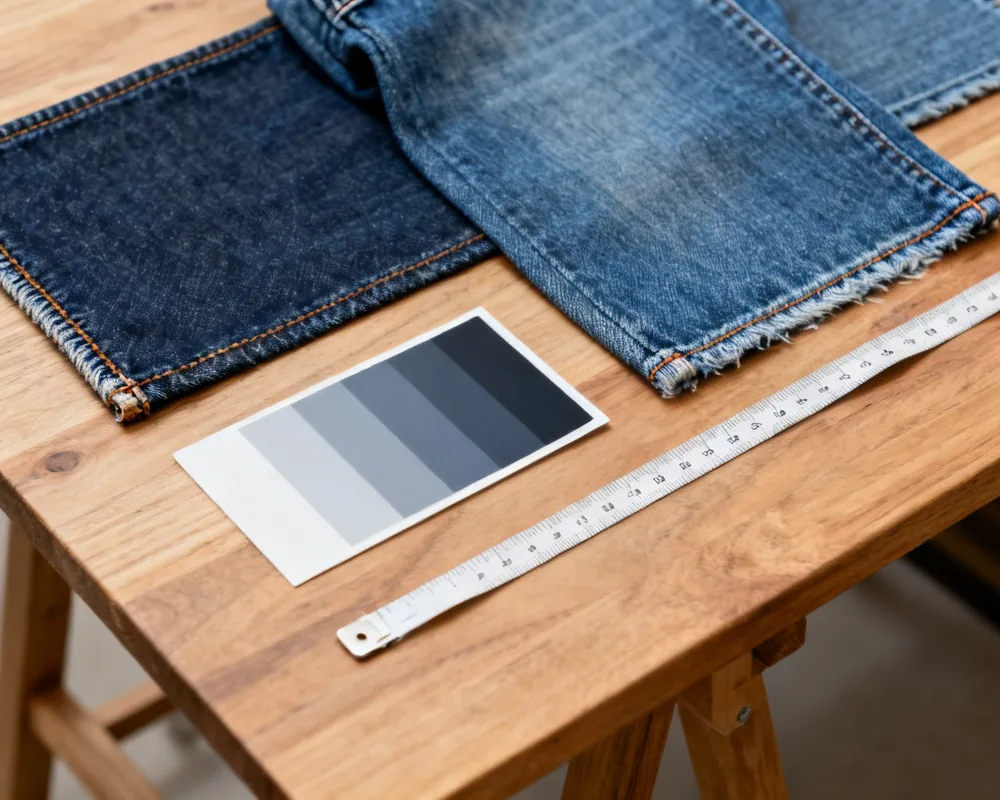
Lay the submitted cutting beside the brief. Check whether the face, the edge ID yarn and the hand match the words on the page. A rigid 100% cotton cloth and a cloth with 2% elastane can share a similar indigo face and still behave differently at the knee. Record the difference you want reviewed: shade, weight, width or finish. A 20 g/m² gap against a 407 g/m² target is a weight question, not a shade question. Do not treat a photograph as a substitute for the physical reference when handle is the open question.
-
3
Approve
Keep the shade reference, the handle note and the finish description on one approval record. A lab dip answers a colour question under a stated light. ISO 139 conditioning is 20 °C and 65% relative humidity; a dip read in that state does not answer dimensional stability after a wet process, and it does not set a shade band for a later roll unless that band is written down. If pilling or abrasion resistance matters for the garment, name the method, such as ISO 12947 for abrasion, and the specimen state instead of borrowing a result from another construction.
-
4
Confirm
Quantity, destination and the approval record are the order context. They sit next to the material reference, but they do not replace it. A conversation about 500 m or about rolls still needs the same composition, GSM and usable width that the sample used. A 500 m figure does not prove the next roll matches a 407 g/m² cutting. Roll inspection points, if you need them, should be listed as checks you want discussed, not as a completed inspection of cloth this site has not seen.
Prepare the next handoff
Share the selvedge reference, the shade note and the destination you are planning around.